
Request a call back! Please fill out our form and our colleague will call you back at the indicated time.
In short: beard transplantation uses the same principle and technology as hair transplantation. For smaller gaps, as few as 200 grafts from under the chin can be enough; for larger areas we also use hair taken from the back of the head, and building a full beard can take up to 2000 hairs. The procedure is done under local anesthesia, and the grafts are extracted painlessly.
Beard transplantation with a sophisticated technique
Nowadays, the demanding and lush facial hair is once again in fashion, and barber services are more and more often available at hairdressers. The dense, properly trimmed beard and moustache is quite fashionable amongst men, even in some communities (like hipsters or lumbersexuals) beard is seen as an object of fetishism. Currently, beard implantation counts as the only available solution by which anyone, even a baby-faced man can grow a thick beard. Patchy facial hair can not be a problem either, so what is missing from the genes can be easily cured by beard transplantation.
The principle and the technology is just the same as by hair transplantation: we use the extracted hair follicles from the patient’s nape as a donor, except for cases, when we have to fill only some minor parts on the face. In these cases, the beard under the chin may also provide the sufficient amount of hair.
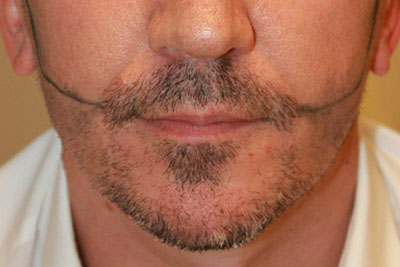
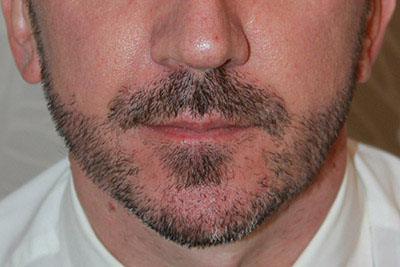


How many hairs are needed for beard implantation?
- To make up minor imperfections even 200 grafts can be enough, from the beard under the chin, which in this case means the same amount of hairs, because in the occasion of a facial hair transplantation, the average graft contains just one hair. On the other hand, determination of the required amount can be specified by examination.
- For the correction of sideburns, 200 grafts per side may also be enough, so long as it is done with hair (extracted from the nape) , then 200-200 hairs.
- However, the implantation of two symmetrical and larger areas per cheek might require even 500-500 grafts. In this case, the amount extracted from under the chin is sometimes not enough, so that in addition to the maximum amount of extracted grafts, we use hair follicle units extracted from the nape area. This way we can implant the mixed follicles in the cheek areas.
- The construction of a full beard is mainly made up from hair extracted directly from the head/nape. This can mean up to 2,000 hairs depending on the size of the cheeks and on the desired beard line.
Planning the beard transplantation
In the case of patchy facial hair
Many reasons can stand behind patchy facial hair: inflamation of the face and neck area, or it can simply be tracked back to genetic reasons. In these cases, of course it is very important to clarify the reasons, and only followed by that, we can manage to plan the beard transplantation process.
For the transplantation of smaller areas, usually, everyone has the right amount of facial hair under the chin. By the help of hair extracted from the neck area, we can make sure that the transplanted beard’s quality would be the same as the surrounding facial hair.
In the case of transplantation on a bigger area
The construction of a full beard, or the completion of larger gaps, is on one hand done with hair extracted from the nape of the neck. The extraction of follicular units is performed by the SafeSystem or the Trivellini FUE method, which are also used in hair transplantation. This way we can ensure having the best results.
It is important to mention that the hairs, extracted from the scalp or nape, will also take on the characteristics of facial hair, so the larger areas transplanted with hair, will also have a natural look.
The process of beard transplantation
The way we manage to plan the beard, depends on whether we should remove hair follicles from a smaller or a larger area. After selecting the appropriate donor area, we cut the hair on the face/nape to the desired length, after that, local anesthesia is used. The grafts are then getting painlessly extracted and transplanted to the desired area, using the method of usual hair transplantation. The implantation of follicular units is done by imitating the natural characteristics of facial hairs, with special regards to the patient’s unique features.
- Before
- After
Frequently asked questions about beard transplantation
How many grafts are needed for a beard transplant?
For smaller gaps, as few as 200 grafts from under the chin can be enough. Correcting sideburns can take as little as 200 grafts per side, two larger symmetrical cheek areas may need 500 grafts per side, and building a full beard can take up to 2000 hairs. The exact number is determined by measurement.
Where does the transplanted hair come from?
For smaller gaps the donor area is the beard under the chin; for larger areas it is the back of the head, where hair-derived follicular units are combined with the maximum number of beard grafts that can be taken.
Will hair transplanted into the beard look natural?
Yes: after a while the hairs transplanted from the head take on the character of facial hair, so even larger areas transplanted with scalp hair look natural.
What method is used?
We extract the follicular units with the SafeSystem or Trivellini FUE method also used for hair transplants. The procedure is done under local anesthesia, the grafts are extracted painlessly and placed following the natural properties of beard hair.
When is it worth considering a beard transplant?
When facial hair is patchy: the cause can be inflammation of the face and neck area or genetic factors. We first clarify the cause and only then start planning the transplant. Request a call back and we will discuss your options.